

By Fernando Del Canto on October 5, 2026
A trust settled in London that owns a villa in Ibiza or on the Côte d’Azur may exist in English law but not on the same terms in Spanish or French law. I set out what a trust is and what it is not, then the arguments of its named defenders and critics. I test both against the residence of the settlor, the trustees and each beneficiary, which decides most cross-border cases.
A US family whose Florida trust holds houses in Marbella, London and the Côte d’Azur through a Panamanian foundation shows how the United States, the United Kingdom, France, Panama and Spain treat the same arrangement. I then propose a supplement to the 1985 Hague Convention for a less multilateral world. I also set out the steps a family might consider when assets or people are in Spain.
I close with my own view, which I offer subject to any better opinion.
What a trust is, and what it is not
A trust is an obligation attached to property, not an entity. A settlor transfers assets to a trustee, who becomes their legal owner and must hold them for beneficiaries, or for a permitted purpose, under the trust instrument and the general law of fiduciary duty. The trust has no legal personality; every act said to be the trust’s is the act of the trustee.
English law requires certainty of intention, of subject matter and of objects before a trust exists, and the Court of Appeal in Armitage v Nurse held that trustees owe an irreducible core of obligations, to act honestly and in good faith for the beneficiaries, which no drafting can exclude.[1] Adult beneficiaries entitled to the whole fund may together call for it and end the trust, and the court supervises what trustees must disclose to them.[2]
The type of trust decides how each tax system treats it. Under a bare trust the beneficiary holds the whole beneficial interest. Under an interest in possession trust a named beneficiary takes the income, with capital passing to others afterwards. Under a discretionary trust the trustees choose among a class, none of whom owns anything until they decide. A revocable trust leaves the settlor able to take the fund back. A protector may hold powers of consent or removal, and a letter of wishes guides the trustees without binding them.
A trust is not a company, a foundation or a contract. Nor is it the Spanish fiducia, the Colombian fiducia mercantil or the Panamanian fideicomiso. In an earlier article at https://www.theinternationalprivateclient.com/2026/08/neither-fiducia-nor-fideicomiso-is-a-trust-a-colombian-and-spanish-perspective/ I suggested that those institutions are related to the trust by function and unrelated to it by structure.
A civil law fiduciary holds ownership under a contract or a statute, while the trust divides ownership itself between legal title and equitable interest. Spanish civil law treats ownership as a single right under Article 348 of the Código Civil, and the Tribunal Supremo, the one time it met a trust, in the Sentencia 338/2008, de 30 de abril, declined to give an Arizona trust effect over Spanish assets.[3]
Who defends the trust, who attacks it, and why?
The case for the trust
As an English barrister, I side with Frederic William Maitland. He called the invention of the trust the largest and most important of equity’s exploits, an institution “as elastic, as general as contract”. Elsewhere he called it “the greatest and most distinctive achievement performed by Englishmen in the field of jurisprudence”. Modesty has never been the English Bar’s strongest subject. As a Spanish abogado, I side with a fellow civilian, Maurizio Lupoi, who argued that the trust can be received into civil law systems and that a civil code survives the experience. Italy took him at his word. It ratified the Hague Convention in 1989 and built the trust interno on that footing. The Principles of European Trust Law of 1999 and Book X of the Draft Common Frame of Reference of 2009 even supply model rules for civil codes. Spain has so far declined the offer.[4]
The practitioner’s case for the trust no longer rests on deferring tax, since the anti-avoidance codes of the United Kingdom and the United States removed most of that advantage years ago. It rests on function.
A trustee can hold assets for a minor, a vulnerable adult or three generations spread across several countries, with no grant of probate needed in each country when the settlor dies. The trust carries on if the settlor loses capacity. A letter of wishes records what the settlor wanted. A court will not enforce it, but the trustees must take it into account, and a decision that disregards it is open to review. The case is less glamorous than tax deferral and a good deal easier to defend before HMRC.
The case against the trust
I understand why anything connected with preserving wealth makes an easy target. I find it harder to accept that a legal institution is judged by its worst clients, when it has served charity since the Statute of Charitable Uses 1601 and still holds pension funds, the endowments of universities and hospitals, family homes and the savings of the vulnerable. Andres Knobel of the Tax Justice Network, in Trusts: Weapons of Mass Injustice? (2017), argued that separating control from benefit lets assets sit beyond the reach of creditors, spouses and tax authorities, and called for comprehensive registration of trusts. The paper shows that trusts can be misused, which is less than its title claims. Its main demand, a register of trust beneficial owners, is now law in the EU and the United Kingdom. Brooke Harrington’s Capital without Borders (2016) describes trusts used to avoid taxes, debts and inheritance rules. Her book studies the wealth managers who sell trusts to the very rich, and it tells us more about that market than about the institution. Katharina Pistor’s The Code of Capital (2019) treats the trust as one of the legal modules that shield assets from creditors, alongside contract, property, collateral and the company. Her critique, which I take seriously, is directed at private law as a whole, and reading it as an indictment of the trust alone misreads her. The World Bank and UNODC study The Puppet Masters (2011) found trusts among the arrangements used to conceal the proceeds of corruption. In the cases it reviewed, companies did that work far more frequently than trusts. The Financial Action Task Force revised Recommendation 25 in February 2023 to require accurate beneficial ownership information on every express trust, and I support that revision. Transparency answers the legitimate part of the critique. The remainder concerns misuse, which calls for enforcing the rules now in place.[5]
In JSC Mezhdunarodniy Promyshlenniy Bank v Pugachev, Birss J held that five New Zealand discretionary trusts holding about USD 95 million, of which Mr Pugachev was settlor, discretionary beneficiary and protector, took effect as bare trusts for him and would have been shams in any event.[6]
The civil law objection is doctrinal rather than moral. Ownership is a single right, real rights form a closed list, and forced heirship protects descendants against dispositions a trust might otherwise defeat.
As I read the debate, the critics describe abuse and the defenders describe function, and each may be right about a different trust. What neither side settles is which country taxes the fund, and that turns on residence.
Residence decides the answer
The same fund can be resident in one country, attributed to a settlor in a second and taxed on distribution in a third.
United Kingdom. The trustees are treated as a single person, UK resident when all of them are; where they are mixed, the settlor’s position when the settlement was made decides. Individuals are resident under the statutory residence test in Schedule 45 to the Finance Act 2013.[7]
United States. A trust is domestic only if a US court can exercise primary supervision over its administration and US persons control all its substantial decisions; every other trust is foreign, and a single foreign trustee with a veto can make it so. US citizens are taxed on worldwide income wherever they live, and others become resident through the green card or substantial presence tests.[8]
Spain. Spanish law has no trust residence, because it has no trust. It looks at the settlor and each beneficiary under Article 9 of the Ley 35/2006, de 28 de noviembre, del IRPF, which turns on more than 183 days in Spain in the calendar year, the centre of economic interests, or the presumption arising from a spouse and minor children resident in Spain. For succession and gift tax the acquirer’s residence decides the scope of the charge, worldwide for residents and Spanish-situs assets only for non-residents, who have had access to the regional reliefs since the Ley 11/2021, de 9 de julio, codified the line opened by Commission v Spain (Case C-127/12, 3 September 2014).[9] The Beckham regime of Article 93 of the Ley 35/2006 changes the income tax position of the person who elects for it and leaves succession and gift tax untouched.
Panama. Panama taxes on a territorial basis, so income from sources outside Panama is not taxed there.[10] For a Panamanian foundation or company holding foreign assets, the real analysis takes place where the assets sit and where the family lives.
Recognition under the Hague Convention
The Hague Convention on the Law Applicable to Trusts and on their Recognition was concluded on 1 July 1985 and entered into force on 1 January 1992.[11] The United Kingdom gave it effect through the Recognition of Trusts Act 1987.[12] It has 14 contracting parties, Panama among them since 1 December 2018; France and the United States signed and never ratified, and Spain, Germany and Ireland never signed.[13]
Recognition under Article 11 means that the trust property is a separate fund, outside the trustee’s own estate on insolvency or death. Article 15 preserves the mandatory rules on minors, matrimonial property, succession including forced shares, transfer of title and the protection of creditors and good faith third parties. Article 13 lets a state refuse recognition where the trust’s significant elements are connected with states that do not know the trust, Article 18 reserves public policy, and Article 19 leaves fiscal powers untouched.
The United States: a trust country outside the Convention
The United States never ratified the Convention, yet the trust is native to the law of every state, and federal tax law addresses it by statute. I am not qualified in the United States, and this section and the worked example summarise the federal rules from published sources; anyone acting on them should take advice from a US-qualified adviser.
The grantor trust rules in sections 671 to 679 of the Internal Revenue Code tax the trust’s income to a settlor who retains defined powers or interests. Section 672(f) narrows that treatment for a non-US settlor to trusts that are revocable or under which only the settlor and spouse can benefit during the settlor’s life, and section 679 treats a US person who transfers assets to a foreign trust with a US beneficiary as their owner. When a foreign trust is not a grantor trust, distributions of accumulated income to a US beneficiary bear the throwback tax and an interest charge under sections 665 to 668.[14]
The estate and gift tax exclusion is USD 15 million per person from 1 January 2026, indexed for inflation; a non-resident who is not a citizen is taxed only on US-situs assets, with a credit equivalent to an exemption of USD 60,000.[15] The income tax convention between Spain and the United States of 22 February 1990, amended by the Protocol of 14 January 2013 in force since 27 November 2019, does not cover inheritance, gift or wealth taxes, and the two countries have no treaty on inheritance and gift taxes.[16]
An unreported distribution from a foreign trust attracts a penalty under section 6677 of the greater of USD 10,000 and 35% of the gross reportable amount.[17]
A worked example: a US family, a Panamanian foundation and three houses
Panama offers two institutions that clients confuse. The fideicomiso of Law 1 of 5 January 1984, amended by Law 21 of 10 May 2017, creates a separate patrimony held by a fiduciary supervised by the Superintendencia de Bancos. The private interest foundation of Law 25 of 12 June 1995 is a legal person with no owner, closer to a Liechtenstein Stiftung than to a trust.[18]
Consider a family from Miami. The father, a US citizen resident in Florida, has settled a revocable trust governed by Florida law, with a Florida trustee. The trust owns a Panamanian private interest foundation, the foundation owns a Panamanian company, and that company owns a villa in Marbella, a flat in London and a house on the Côte d’Azur. His daughter, also a US citizen, lives in Madrid under the Beckham regime; his son, a US citizen, lives in London. The facts are illustrative. My qualifications are in England and Wales and in Spain, and what I say about US, French and Panamanian law summarises published rules that would need confirmation from an adviser qualified in each country.

Figure 1. The family structure. Illustrative facts.
In the United States. The trust passes the court and control tests, so it is a domestic grantor trust; the father is taxed on its income under section 676 and the fund is in his estate under section 2038, against the exclusion of USD 15 million. The foundation may be classified as a foreign trust or as a foreign corporation, depending on its terms, and the classification decides the reporting. The Panamanian company is likely to be a controlled foreign corporation, because its shares are attributed to the father and his children; rents from houses it does not actively manage are taxed currently as foreign personal holding company income, and the layers bring Forms 5471 and 8938 and, if the foundation is a trust, Forms 3520 and 3520-A. Section 2014 credits foreign death taxes only on property situated in the taxing country,[19] and shares in a Panamanian company are situated in neither the United Kingdom nor France, so relief for UK or French tax on the houses depends on the 1978 conventions on estates and gifts with those countries; there is none with Spain.[20]
London. The company must register its beneficial owners, the trustee included, on the Register of Overseas Entities, and if the flat is worth more than GBP 500,000 and no relief applies, such as the relief for property let commercially, it pays the Annual Tax on Enveloped Dwellings each year. Schedule A1 to the Inheritance Tax Act 1984 looks through the foundation and the company to the flat, so that UK inheritance tax can reach it on the father’s death and under the charges on settled property.[21] Paragraph 7 of Schedule A1 preserves that charge despite a treaty where the other country charges no tax, or tax at an effective rate of 0%. HMRC accepts that if the father’s estate actually bears US estate tax, the 1978 UK-US convention denies the UK charge; if the estate falls within the US exclusion, the UK charge stands.

Figure 2. UK inheritance tax on the London flat under Schedule A1 to the Inheritance Tax Act 1984 and the 1978 UK-US estate convention. Source: HMRC, IHTM04315.
The Côte d’Azur. France charges 3% a year on the market value of French immovable property held through legal entities under Article 990 D of the Code général des impôts; the company can avoid it only by declaring its owners, and its position turns on how France classifies Panama at the time. Family members resident outside France are liable to the impôt sur la fortune immobilière on French immovable property held indirectly, above net wealth in immovable property of EUR 1.3 million. On death, shares in a company whose assets consist mainly of French immovable property are French property for succession duties under Article 750 ter, and the 1978 France-US convention, as amended by its Protocol of 8 December 2004, treats shares in a company at least half of whose assets are French immovable property as French immovable property, so both rules turn on the house’s share of the company’s assets. I state these French rules for illustration only; their application to this family is a matter for French advice. The trustee may have to declare the trust under Article 1649 AB, failing which the annual levy of 1.5% under Article 990 J applies.[22]
Marbella. Panama is not on the Spanish list of non-cooperative jurisdictions. It left the earlier list when the convention between Spain and Panama of 7 October 2010 entered into force on 25 July 2011, and neither Orden HFP/115/2023 nor its amendment by Orden HAC/649/2026 restored it. The Panamanian company therefore falls outside the special levy of 3% of cadastral value in Articles 40 to 45 of the TRLIRNR, which reaches only entities resident in a non-cooperative jurisdiction. It pays non-resident income tax on any rents. The imputed income charge on unlet dwellings applies to individuals, not to companies. The convention does not extend to every layer. Under paragraph VII(2) of its Protocol, Articles 6 to 22 do not apply to private interest foundations unless information on their beneficiaries and on the income they obtain and distribute can be obtained. On a sale the purchaser withholds 3% of the price under Article 25.2 of the TRLIRNR. Since the Ley 38/2022, de 27 de diciembre, with effect from 29 December 2022, non-residents have been liable to the Spanish wealth taxes on shares in entities whose assets consist, directly or indirectly, at least 50% of Spanish immovable property. Where the Spain-Panama convention applies, its Article 22(4) preserves that right for Spain. The family’s exposure therefore depends on what share of the company’s assets the villa represents, and how far the rule reaches through several foreign layers is not settled. If Spain disregards the trust and attributes the shares to the father, he has no protection from the Spanish wealth taxes under either convention. The US-Spain convention covers income only, and the Spain-Panama convention does not apply to a US resident. At the Registro de la Propiedad, the Dirección General de los Registros y del Notariado upheld in 2008 a refusal to register an acquisition by a Panamanian private interest foundation. If the structure is kept, title in the company’s name seems to me the safer course.[23]
The daughter in Madrid. Spain will disregard the US trust, but it may respect the foundation, as the DGT did for a Liechtenstein foundation with its own legal personality in binding ruling V0609-22.[24] If the foundation is respected, nothing passes to her on her father’s death, and what she later receives from the foundation would be income rather than an inheritance; while the Beckham regime lasts, receipts from a foreign entity should in principle fall outside her Spanish base. If Spain looks through the foundation as well, the death is a direct inheritance taxed on her worldwide acquisition as a Madrid resident, with the regional reliefs and a credit under Article 23 of the LISD for US estate tax only so far as it is a similar tax on the same acquisition, and the Beckham regime does not help. Which reading applies is, in my view, the most uncertain point in the structure, and a binding ruling before she moved might well have been worth its cost.
The son in London. Apart from the flat, his receipts from the foundation, if it is treated as a settlement, are matched to gains under section 87 of the Taxation of Chargeable Gains Act 1992 or taxed under the transfer of assets abroad code, subject to the four-year foreign income and gains regime, and as a US citizen he makes tax returns in both countries; the UK-US income tax convention of 24 July 2001 preserves US taxation of citizens, so relief comes through credits rather than exemption. Calling the payment a gift does not change the UK result, because a capital payment under section 97 of the 1992 Act and a benefit under section 731 of the Income Tax Act 2007 both include gratuitous payments. In the United States, by contrast, a distribution from a grantor trust is a gift from the grantor and not income of the beneficiary. A gift the father makes from his own funds is outside both UK codes, provided it is not an onward gift of a trust distribution under section 87I of the 1992 Act.

Figure 3. How each country characterises each layer. Author’s analysis.
Each layer now carries its own registration and charge in at least one of the four countries. For this family the course I would explore first is to keep the US trust as the governing instrument, hold each house directly or through a company in the country where it sits, and either give the Panamanian layers a purpose beyond privacy or remove them. The residence and citizenship of each person, and the location of each house, decide the answer, and any such course would need advice in each of the four countries on the family’s full facts.
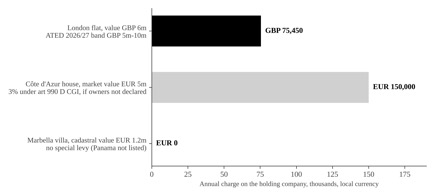
Figure 4. Annual entity-level charges on the three houses. Illustrative values; ATED band for 2026/27 from GOV.UK; CGI art 990 D. No special levy in Spain, since Panama is not a non-cooperative jurisdiction.
Spain: a legal system without the trust
Spain has not signed the 1985 Convention and has no domestic trust. The Dirección General de Tributos (DGT) and, since 2025, the Tribunal Económico-Administrativo Central (TEAC) have built an administrative doctrine on that premise. For Spanish purposes, the relationships between settlor, trustee and beneficiaries are read as if the trust did not exist, and a distribution is treated as a direct transfer from settlor to beneficiary.[25]
- Succession and gift tax. A distribution to an individual is an inheritance or a gift from the settlor under the Ley 29/1987, de 18 de diciembre (LISD), charged when it occurs; where the beneficiary’s powers are equivalent to ownership from the outset, the DGT places the taxable event at the settlement.[26]
- Transfer tax. Settling a trust is not a capital contribution taxable under the operaciones societarias head, because the trust has no legal personality in Spain.[27]
- Wealth taxes. Assets count in the net wealth of whoever Spanish law treats as owner, for the Impuesto sobre el Patrimonio and for the Impuesto Temporal de Solidaridad de las Grandes Fortunas (ITSGF), which charges net wealth above EUR 3 million at rates from 1.7% to 3.5%.[28]
- Non-resident property. A non-resident individual who owns a Spanish dwelling not let out declares imputed income of 2% of cadastral value, or 1.1% where the value was revised, taxed at 19% for EU and EEA residents and 24% for others.[29]
A Spanish notary and the Registro de la Propiedad have no category for a trustee. A British national resident in Spain may choose English law for the succession under Article 22 of Regulation (EU) No 650/2012, which in principle displaces the forced share of Articles 806 to 808 of the Código Civil, although the trust itself is still not recognised.[30]
For anti-money laundering purposes, Article 4.2(c) of the Ley 10/2010, de 28 de abril, names settlors, trustees, protectors and beneficiaries as beneficial owners, recorded in the Registro Central de Titularidades Reales created by the Real Decreto 609/2023, de 11 de julio.[31] A Spanish resident who is a beneficial owner of a trust holding foreign assets above EUR 50,000 per category may therefore have to submit Modelo 720 even where the DGT does not treat that person as owner for wealth tax.[32]
Civil law hybrids and the transparency rules
Between full recognition and none sit civil law systems with a domestic fiduciary institution. France has the fiducie of Article 2011 of the Code civil but has not ratified the Convention, and taxes foreign trusts under its own definitions; Italy admits the trust interno; Switzerland and Luxembourg apply the Convention; Colombia’s fiducia mercantil allows a foreign trust to be understood by analogy but not recognised; and the DIFC and ADGM offer trust regimes inside the UAE’s financial free zones.[33] I describe these systems from published sources and am not qualified in any of them.
Recognition and registration are now independent of each other. Directive (EU) 2018/843 requires registers of trust beneficial ownership, access to which has depended on a legitimate interest since WM and Sovim SA v Luxembourg Business Registers (Joined Cases C-37/20 and C-601/20, 22 November 2022), and Regulation (EU) 2024/1624 applies from 10 July 2027.[34] The UK Trust Registration Service requires registration within 90 days and the Irish register within six months of creation,[35] and the Common Reporting Standard and hallmark D2 of the DAC6 rules complete the picture.[36]
The UK after 6 April 2025
From 6 April 2025 the UK replaced domicile with long-term residence as the connecting factor for inheritance tax. An individual is a long-term resident after UK residence in at least 10 of the previous 20 tax years, and whether non-UK trust assets are excluded property now depends on the settlor’s status at each charging occasion.[37]
For a non-UK trust with a long-term resident settlor, the relevant property regime applies, with a charge of up to 6% on each ten-year anniversary and an exit charge, capped at GBP 5 million per ten-year cycle for trusts that held excluded property on 30 October 2024.[38] The settlements code, sections 86 and 87 of the Taxation of Chargeable Gains Act 1992 and the transfer of assets abroad code attribute trust income and gains to UK-resident settlors and beneficiaries.[39]
The UK-Spain Convention of 14 March 2013 covers income and capital only; under Article 4(4) and its Protocol it looks through a UK trust to a Spanish-resident beneficiary, taxed in Spain on the gross income with credit for UK tax, and it says nothing about a settlor’s death. Spain has inheritance tax treaties only with France, Greece and Sweden, so double charges are relieved, if at all, by the unilateral credits in Article 23 of the LISD and section 159 of the Inheritance Tax Act 1984.[40]
A Hague protocol for a less multilateral world
The 1985 Convention was drafted in a period of confidence in multilateral law-making. Forty years on it has 14 contracting parties, and Germany, France, Spain and the United States remain outside it. On 20 January 2025 the President of the United States declared that the OECD global tax deal had no force or effect in the United States absent an act of Congress, and on 28 June 2025 the G7, under the Canadian presidency, accepted a side-by-side arrangement leaving US-parented groups outside parts of the global minimum tax.[41] Waiting for universal ratification of an unamended text seems to me unlikely to help families soon.
I would tentatively suggest a protocol to the Convention, built in modules that states could accept separately.
- A fiscal declaration module. Without disturbing Article 19, each accepting state would publish how it attributes trust assets and income, by type of trust, to settlor, trustee or beneficiary, and would apply its declared rule whether it raises or lowers the charge. Nothing would be harmonised; the rule would simply become public and symmetrical.
- Recognition linked to registration. Recognition under Chapter III could be conditioned on the trust appearing in a beneficial ownership register that meets FATF Recommendation 25, which answers much of the critics’ concern and gives civil law states a reason to recognise what they can see.[42]
- Bilateral activation. States could choose the partners with which the protocol applies. Article 29 of the HCCH 2019 Judgments Convention already allows a state to declare that the Convention will not create relations with a named state, and the Protocol of 23 November 2007 on the Law Applicable to Maintenance Obligations shows that the Hague Conference can supplement an existing instrument, with the European Union joining as a regional organisation.[43] The fate of the opt-in bilateral mechanism of the 1971 Judgments Convention, which attracted few states, is a caution against making activation burdensome.
- A schedule of equivalent institutions. Accepting states could list domestic institutions, such as the Panamanian fideicomiso, the Colombian fiducia mercantil and the French fiducie, that they agree to treat as within Article 2, reducing disputes over characterisation.
These are a practitioner’s suggestions rather than a treaty negotiator’s. Their value, if any, lies in accepting that cooperation may now advance among smaller groups of states that trust each other, rather than through a single global text.
Compliance where the assets or the people are in Spain
A trust with Spanish assets or Spanish-resident family members can be held in full compliance if each country’s description of the trust is treated as binding within that country. The steps are general, and each family’s facts will change them.
- Fix residence first. Determine, for each tax year, the residence of the settlor, each trustee, the protector and each beneficiary under each country’s own test, and record the situs of each asset and the governing law of the trust alongside.
- Characterise the trust under Spanish law in advance. Identify whom the DGT will treat as owner at each stage and when LISD will fall due. Where the facts are new, a binding ruling under Articles 88 and 89 of the Ley 58/2003, de 17 de diciembre, General Tributaria, settles the characterisation for the applicant.[44]
- Choose how Spanish immovable property is held. Direct holding, a Spanish or EU company, and a trustee, company or foundation in a non-cooperative jurisdiction such as the Cayman Islands lead to different charges, and only the last risks the 3% special levy every year.
- Register and report everywhere it applies. The UK Trust Registration Service, the Spanish Registro Central de Titularidades Reales, the Irish register, a Spanish tax identification number (NIF) for any trustee acquiring Spanish assets, Modelos 720, 721 and 210, and Forms 3520 and 3520-A for US persons.
- Align the will, the trust and each distribution. Choose the law of the succession expressly under Article 22 of Regulation (EU) No 650/2012, keep the letter of wishes consistent with the will, and treat each distribution as a taxable event in the beneficiary’s country of residence.
- Run the trust as a trust, and review it on every change of residence. Trustee minutes, independent decisions and accounts answer the English sham inquiry and the Spanish simulation analysis.[45] Any move, death, new trustee or new asset requires the record in step 1 to be revised.
Where a step requires a Spanish notary, an English solicitor, a US lawyer, a French notaire or a Panamanian fiduciary, that work should be instructed separately; a barrister’s opinion does not substitute for it.
Where I stand, and where I may be wrong
I write as a barrister of twenty years’ standing at the English Bar and as a Spanish abogado. When I criticise Spain’s treatment of the trust, I do so as a Spaniard who would like his own system to do better.
I regard the trust as a legal instrument, judged by what its deed requires of the trustees, and not as a vehicle for whatever the settlor wishes to move. The trust deed, the letter of wishes and a family protocol can serve as the governing documents of a family office, with companies beneath them holding and running the assets. The critics are right that a trust can be used to hide assets, and on those uses I share their concern.
My sense is that beneficial ownership registers, the Common Reporting Standard and the revised FATF standard have answered much of it. Pugachev shows that an English court will treat assets as the settlor’s own where he kept control of them in substance. I accept that enforcement is uneven, and that those who study abuse see cases that never reach my desk.
For families with Spanish connections, the difficulty I meet most is the Spanish response, which I have described in earlier articles as selective transparency. The administration looks through the trust where that raises the charge, as in attributing the fund to a Spanish resident for the ITSGF, and, in my experience, relies on the trust’s legal non-existence where recognition would lower it, for instance on the character of distributed income. The look-through limb is documented in DGT rulings and TEAC resolutions; the non-recognition limb rests more on inspection practice than on published doctrine, and I would welcome evidence either way.[46] I am more confident that the doctrine is administrative rather than judicial, since the Tribunal Supremo has addressed the trust once, in 2008, on a succession question.

Figure 5. Selective transparency in Spanish administrative practice. Sources: DGT V0986-25; TEAC resolutions of 22 January and 30 May 2025.
Looking through a trust is not in itself my objection. Section 624 of the Income Tax (Trading and Other Income) Act 2005 and the US grantor trust rules do the same.[47] The difference I see is that those systems decide by statute when the fund is attributed and to whom, while Spain decides case by case. I doubt that ratification alone would settle this, because Article 19 preserves each state’s fiscal powers; the Netherlands ratified and still legislated, attributing the assets of an afgezonderd particulier vermogen to the settlor under Article 2.14a of the Wet inkomstenbelasting 2001.[48] Aragonese law already knows the fiducia sucesoria, which suggests to me that the obstacle is legislative will rather than legal culture.[49] I incline to the view that a Spanish statute, with or without ratification, and a protocol of the kind sketched here, would serve families better than the present doctrine.
I may be wrong in more than one respect. The administrative doctrine offers a single, predictable rule of attribution, and a statute drafted in haste could be harsher than the rulings it replaced. Ratification could invite years of litigation over Articles 13 and 15, and a protocol may prove as hard to negotiate as the Convention has been to ratify. I hold these views open to correction, and I would welcome colleagues who read the DGT and TEAC doctrine differently, or who can point me to Tribunal Supremo authority on tax I have not found.
In the cross-border trusts I have advised on, the first question has been where each member of the family lives, and the second what each country will make of the trust on that basis. The trust has mattered less than the residence of the people it serves.
Should Spain ratify the Hague Trusts Convention, legislate a tax regime for trusts as the Netherlands did, support a protocol of the kind proposed here, or leave the present doctrine as it stands?
This article reflects a personal opinion and does not constitute legal advice. Statements on the law of the United States, France, Panama and other jurisdictions in which the author is not qualified summarise published sources and should be confirmed by advisers qualified there.
León Fernando Del Canto is a dual-qualified barrister and abogado and founder of Del Canto Chambers, an Anglo-Spanish private client practice in London and Madrid advising on UK-Spain cross-border tax, succession and residence.
[1]Knight v Knight (1840) 3 Beav 148; Armitage v Nurse [1998] Ch 241 (CA).
[2]Saunders v Vautier (1841) Cr & Ph 240; Schmidt v Rosewood Trust Ltd [2003] UKPC 26, [2003] 2 AC 709.
[3]Código Civil, art 348; STS (Sala de lo Civil) 338/2008, de 30 de abril; LF Del Canto, ‘Neither fiducia nor fideicomiso is a trust’ (The International Private Client, 9 August 2026) <https://www.theinternationalprivateclient.com/2026/08/neither-fiducia-nor-fideicomiso-is-a-trust-a-colombian-and-spanish-perspective/>.
[4]FW Maitland, Equity (AH Chaytor and WJ Whittaker eds, rev J Brunyate, 2nd edn, CUP 1936) 23; FW Maitland, ‘The Unincorporate Body’ in HAL Fisher (ed), The Collected Papers of Frederic William Maitland, vol 3 (CUP 1911) 271, 272; M Lupoi, Trusts: A Comparative Study (CUP 2000); Legge 16 ottobre 1989, n 364; DJ Hayton, SCJJ Kortmann and HLE Verhagen (eds), Principles of European Trust Law (Kluwer 1999); C von Bar, E Clive and H Schulte-Nölke (eds), Draft Common Frame of Reference (Sellier 2009) Book X.
[5]Statute of Charitable Uses 1601; A Knobel, Trusts: Weapons of Mass Injustice? (Tax Justice Network 2017); Directive (EU) 2018/843, art 1(16); Joined Cases C-37/20 and C-601/20 WM and Sovim EU:C:2022:912; SI 2017/692, reg 45; B Harrington, Capital without Borders (HUP 2016); K Pistor, The Code of Capital (PUP 2019); E van der Does de Willebois and others, The Puppet Masters (World Bank and UNODC 2011); FATF Recommendations (as amended), r 25.
[6]JSC Mezhdunarodniy Promyshlenniy Bank v Pugachev [2017] EWHC 2426 (Ch).
[7]Income Tax Act 2007, s 475; Taxation of Chargeable Gains Act 1992, s 69; Finance Act 2013, sch 45.
[8]26 USC § 7701(a)(30)(E), (a)(31)(B) and (b); 26 CFR § 301.7701-7.
[9]LIRPF, arts 9.1 and 93; Ley 29/1987, de 18 de diciembre (LISD), arts 6 and 7 and DA 2ª, as amended by Ley 11/2021, de 9 de julio; Case C-127/12 Commission v Spain (3 September 2014); DGT V3151-18; on the Beckham regime, <www.delcantochambers.com>.
[10]Código Fiscal de la República de Panamá, art 694.
[11]Hague Convention of 1 July 1985, arts 2, 11, 13, 15, 18 and 19.
[12]Recognition of Trusts Act 1987, s 1 and sch.
[13]HCCH, status table of the Convention of 1 July 1985 <www.hcch.net>.
[14]26 USC §§ 665 to 668 and 671 to 679.
[15]26 USC §§ 2010(c)(3) and 2102(b)(1), as amended by Pub L 119-21 (4 July 2025).
[16]Spain-US Convention of 22 February 1990, as amended by the Protocol of 14 January 2013 (in force 27 November 2019).
[17]26 USC §§ 6048 and 6677.
[18]Ley 1 de 5 de enero de 1984, as amended by Ley 21 de 10 de mayo de 2017; Ley 25 de 12 de junio de 1995.
[19]26 USC §§ 676, 951 to 965, 2014, 2038, 6038 and 6038D; 26 CFR §§ 301.7701-3, 301.7701-4 and 301.7701-7.
[20]UK-US Convention on estates and gifts of 19 October 1978; France-US Convention on estates, inheritances and gifts of 24 November 1978.
[21]Economic Crime (Transparency and Enforcement) Act 2022, pt 1; Finance Act 2013, pt 3; Inheritance Tax Act 1984, sch A1, para 7; HMRC, Inheritance Tax Manual IHTM04315.
[22]Code général des impôts, arts 750 ter, 964, 965, 990 D, 990 J and 1649 AB; France-US Convention of 24 November 1978, art 5, as replaced by the Protocol of 8 December 2004, art III.
[23]Spain-Panama Convention of 7 October 2010 (BOE 4 July 2011), art 22(4) and Protocol para VII(2); Orden HFP/115/2023, de 9 de febrero, as amended by Orden HAC/649/2026, de 21 de junio; TRLIRNR, arts 25.2 and 40 to 45; Ley 19/1991, art 5.1, as amended by Ley 38/2022, de 27 de diciembre, DF 3ª; Resolución DGRN de 24 de enero de 2008; LF Del Canto, ‘Rethinking the Spanish Property Corporate Shield’ (The International Private Client, 20 June 2026) <https://www.theinternationalprivateclient.com/2026/06/the-spanish-holiday-home-for-the-usa-irish-and-uk-property-owner/>.
[24]DGT V0609-22 (23 March 2022).
[25]DGT V1495-16, V0817-18, V2033-22 and V0986-25; TEAC, resolutions of 22 January 2025 and 30 May 2025 (RG 00/05163/2024).
[26]LISD, arts 3, 6 and 7; DGT V0817-18.
[27]Real Decreto Legislativo 1/1993, de 24 de septiembre (ITPAJD); DGT V1016-10.
[28]Ley 19/1991, de 6 de junio, del Impuesto sobre el Patrimonio; Ley 38/2022, de 27 de diciembre, art 3.
[29]TRLIRNR, arts 24 and 25.1; LIRPF, art 85; AEAT, Manual práctico de tributación de no residentes (2026).
[30]Regulation (EU) No 650/2012, arts 1(2)(j) and 22 and recital 13; Código Civil, arts 806 to 808.
[31]Ley 10/2010, de 28 de abril, art 4.2(c), as amended by Real Decreto-ley 7/2021; Real Decreto 609/2023, de 11 de julio.
[32]Ley 58/2003, General Tributaria (LGT), DA 18ª; Real Decreto 1065/2007, arts 42 bis, 42 ter and 54 bis; Case C-788/19 Commission v Spain (27 January 2022); Ley 5/2022, de 9 de marzo.
[33]Code civil, art 2011; CGI, arts 792-0 bis, 1649 AB and 990 J; Legge 16 ottobre 1989, n 364; Swiss Federal Act on Private International Law, arts 149a to 149e; Luxembourg, loi du 27 juillet 2003; Código de Comercio de Colombia, arts 1226 to 1244; DIFC Law No 4 of 2018; ADGM Trusts (Special Provisions) Regulations 2016.
[34]Joined Cases C-37/20 and C-601/20 WM and Sovim SA v Luxembourg Business Registers EU:C:2022:912; Regulation (EU) 2024/1624, art 90; Directive (EU) 2024/1640.
[35]SI 2017/692, pt 5, as amended by SI 2020/991; SI No 194 of 2021 (Ireland), as amended by SI No 440 of 2025.
[36]Council Directive 2014/107/EU; Council Directive (EU) 2018/822, annex IV, hallmark D2; Ley 10/2020, de 29 de diciembre.
[37]Inheritance Tax Act 1984, ss 6A to 6C and 48, as inserted and amended by Finance Act 2025, s 44 and sch 13; LF Del Canto, ‘Taxing Income or Taxing Wealth? The Real Arithmetic of an Anglo-Spanish Move’ (The International Private Client, 8 July 2026) <https://www.theinternationalprivateclient.com/2026/07/taxing-income-or-taxing-wealth-the-real-arithmetic-of-an-anglo-spanish-move/>.
[38]Inheritance Tax Act 1984, ss 64, 65 and 75B, inserted by Finance Act 2026, s 74.
[39]ITTOIA 2005, ss 619 to 648; TCGA 1992, ss 86 and 87; ITA 2007, ss 714 to 751.
[40]UK-Spain Convention of 14 March 2013, arts 2 and 4(4) and Protocol paras II and V; LISD, art 23; Inheritance Tax Act 1984, s 159.
[41]Presidential Memorandum of 20 January 2025, ‘The Organization for Economic Co-operation and Development (OECD) Global Tax Deal’ (90 Fed Reg, 30 January 2025); G7, Statement on Global Minimum Taxes (28 June 2025).
[42]See n 5.
[43]HCCH Judgments Convention of 2 July 2019, art 29; HCCH Protocol of 23 November 2007 on the Law Applicable to Maintenance Obligations; Council Decision 2009/941/EC; HCCH Convention of 1 February 1971 and its Supplementary Protocol.
[44]LGT, arts 88 and 89.
[45]Snook v London and West Riding Investments Ltd [1967] 2 QB 786 (CA); A v A [2007] EWHC 99 (Fam), [2007] 2 FLR 467; LGT, art 16.
[46]LF Del Canto, ‘Anglo-Saxon trusts in Spain: the problem of selective transparency’ (The International Private Client, 2 June 2026) <https://www.theinternationalprivateclient.com/2026/06/anglo-saxon-trusts-in-spain-the-problem-of-selective-transparency/>; DGT V0986-25; TEAC, resolutions of 22 January 2025 and 30 May 2025; STS 338/2008, de 30 de abril.
[47]ITTOIA 2005, s 624; 26 USC §§ 671 to 679.
[48]Hague Convention of 1 July 1985, art 19; Wet inkomstenbelasting 2001, art 2.14a; LF Del Canto, ‘Common Law and Continental Law on Trusts: The Dutch Example’ (The International Private Client, 25 June 2026) <https://www.theinternationalprivateclient.com/2026/06/common-and-continental-law-on-trusts/>.
[49]Decreto Legislativo 1/2011, de 22 de marzo, Código del Derecho Foral de Aragón, arts 439 to 463.